Skupper Model Provider
Expose remote GPU-hosted LLM models to localhost via a Skupper V2 Virtual Application Network. Separates one-time infrastructure setup from daily start/stop operations.
Architecture
Interactive diagrams: VAN Topology · Operational Lifecycle
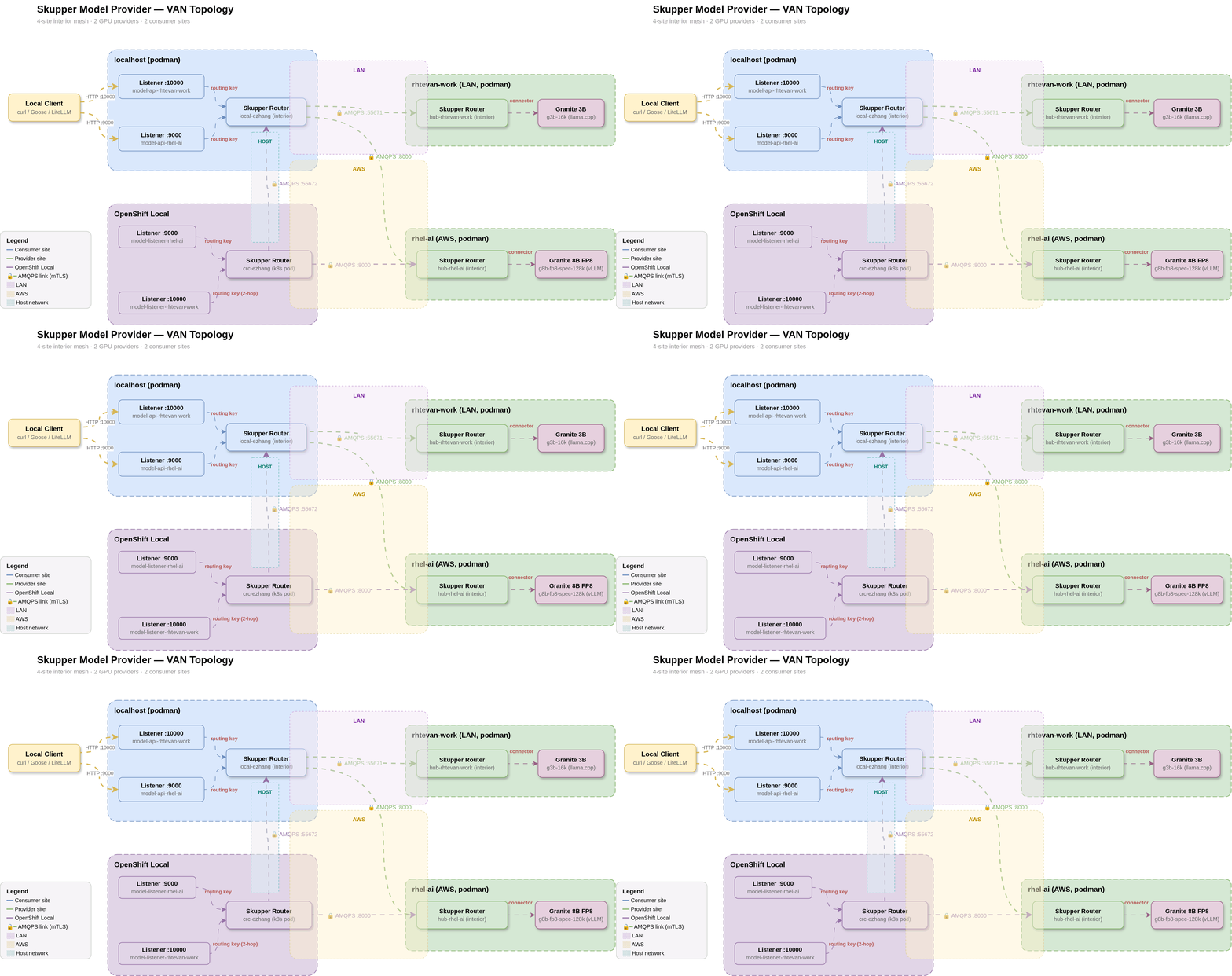
LOCAL: LOCAL_SITE_NAME (localhost, podman)
  ├── link → hub-rhel-ai
  │     host:  RHEL_AI_PUBLIC_HOST
  │     port:  RHEL_AI_INTER_ROUTER_PORT (AMQPS)
  │     Listener :RHEL_AI_MODEL_PORT ← RHEL_AI_ROUTING_KEY
  │
  └── link → hub-rhtevan-work
        host:  RHTEVAN_WORK_PUBLIC_HOST
        port:  RHTEVAN_WORK_INTER_ROUTER_PORT (AMQPS)
        Listener :RHTEVAN_WORK_MODEL_PORT ← RHTEVAN_WORK_ROUTING_KEY

CRC: CRC_SITE_NAME (kubernetes, CRC_NAMESPACE)
  ├── link → hub-rhel-ai
  │     host:  RHEL_AI_PUBLIC_HOST
  │     port:  RHEL_AI_INTER_ROUTER_PORT (AMQPS)
  │     Listener :CRC_MODEL_PORT ← CRC_ROUTING_KEY
  │     Service: model-listener-rhel-ai.CRC_NAMESPACE:CRC_MODEL_PORT
  │
  └── link → local-ezhang
        host:  host.crc.testing (192.168.127.254)
        port:  LOCAL_INTER_ROUTER_PORT (AMQPS)
        Listener :CRC_RHTEVAN_MODEL_PORT ← RHTEVAN_WORK_ROUTING_KEY
        Service: model-listener-rhtevan-work.CRC_NAMESPACE:CRC_RHTEVAN_MODEL_PORT
All site-specific values (IPs, hostnames, ports, SANs) are read from
topology.env. Run setup.sh --check to see the full topology
diagram with actual values and validate the configuration.
Host-Based Routing
Skupper routes by host:port. The active model is determined by
hosted-model-ctl (profile-based mutual exclusion), not by Skupper.
| Host | Local Port | Routing Key | Default Profile |
|---|---|---|---|
| rhtevan-work | 10000 | model-api-rhtevan-work |
g3b-16k |
| rhel-ai | 9000 | model-api-rhel-ai |
g8b-fp8-spec-128k |
The test-model.sh script and up.sh/down.sh scoped operations
accept either a host name (rhel-ai) or a profile name
(g8b-fp8-spec-128k) — profile names are resolved to their host.
Site Configuration
| Site Name | Host | Platform | Mode | Link Port | Model Port |
|---|---|---|---|---|---|
| LOCAL_SITE_NAME | localhost | podman | Interior (outbound + inbound) | LOCAL_INTER_ROUTER_PORT | — |
| hub-rhtevan-work | RHTEVAN_WORK_SSH_HOST | podman | Interior hub | RHTEVAN_WORK_INTER_ROUTER_PORT | RHTEVAN_WORK_MODEL_PORT |
| hub-rhel-ai | RHEL_AI_SSH_HOST | podman | Interior hub | RHEL_AI_INTER_ROUTER_PORT | RHEL_AI_MODEL_PORT |
| CRC_SITE_NAME | CRC cluster | kubernetes | Interior (outbound) | — | CRC_MODEL_PORT, CRC_RHTEVAN_MODEL_PORT |
All values in the table above are defined in topology.env.
- Topology config:
topology.env(site-specific IPs, hostnames, SANs, CRC config) - Shared config:
scripts/common.sh(site profiles, aliases, helper functions) - Router image:
quay.io/skupper/skupper-router:3.5.1 - Podman namespace:
model-provider-podman - CRC namespace:
model-provider-crc - CRC operator: Red Hat
skupper-operatorv2.2.1 (stable-2.2channel, AllNamespaces mode inopenshift-operators) - System controller:
--reload-type auto(cert rotation, config reconciliation)
Script Separation
| Script | Purpose | When to use |
|---|---|---|
setup.sh |
One-time infrastructure | First time, or after teardown |
setup.sh --check |
Precheck only (topology + validation) | Before setup, or to inspect topology |
teardown.sh |
Remove infrastructure | Decommissioning |
up.sh [HOST] |
Start VAN (controllers + routers) | Daily use (HOST = rhel-ai, rhtevan-work, crc, localhost, or all) |
down.sh [HOST] |
Stop VAN (routers + controllers) | End of day (HOST = rhel-ai, rhtevan-work, crc, localhost, or all) |
status.sh |
Full health check | Troubleshooting |
test-model.sh HOST_OR_PROFILE |
E2E connectivity test | Verification |
Agent Orchestration
This skill manages Skupper VAN infrastructure only. Model container
lifecycle is handled by hosted-model-ctl — the agent semantically
triggers that skill (loads and follows its instructions), NOT by
cross-referencing or invoking its scripts directly.
Site Roles
| Role | Sites | What “start” includes |
|---|---|---|
| Model Provider | rhel-ai, rhtevan-work | VAN infra (controller + router) + model containers (via hosted-model-ctl) |
| Model Consumer | localhost, CRC | VAN infra only (controller + router + listeners/links) |
The agent MUST understand this distinction: hosted-model-ctl is only
triggered for Provider sites that are up and reachable.
Signal Routing Rules
“Model” is implied — the skill name already establishes context.
Both short (start skupper) and long (start skupper model) forms
are accepted.
| Signal pattern | Script invocation |
|---|---|
setup skupper |
setup.sh (infra + model setup delegated) |
teardown skupper |
teardown.sh (remove infra, models stopped by script) |
start skupper |
up.sh (VAN + default DPs — all handled by script) |
stop skupper |
down.sh (models stopped + VAN — all handled by script) |
start skupper with PROFILE |
up.sh <HOST> --profile <PROFILE> (agent resolves profile → host) |
start skupper on PROVIDER |
up.sh <HOST> (default DP started by script) |
stop skupper on PROVIDER |
down.sh <HOST> (active DP stopped by script) |
start skupper on CONSUMER |
up.sh <HOST> (VAN only — no model delegation) |
stop skupper on CONSUMER |
down.sh <HOST> (VAN only — no model delegation) |
check skupper / skupper status |
status.sh + hosted-model-ctl list.sh |
The on HOST modifier works for any site name — provider or
consumer. When the target is a consumer site (crc, localhost),
only VAN infrastructure is affected; hosted-model-ctl is never
triggered.
Scoping Rules
- Without
on HOST→ action applies to ALL sites (providers + consumers) - Without
with PROFILE→up.shuses default profile per host (deterministic — no agent decision) - With
on PROVIDER_HOST→ scope VAN + model to that provider - With
on CONSUMER_HOST(crc,localhost) → scope VAN only, no model delegation - With
with PROFILE→ agent resolves profile to its host, passes--profileto script
Name Resolution (Agent Responsibility)
Before calling up.sh or down.sh, the agent resolves user’s natural
language to exact site and profile names:
- Run
up.sh --list-sites→ get valid site names - If user specified a profile, run
hosted-model-ctl/scripts/list.sh --names-only <site>→ get valid profile names - Match user’s input against valid names (semantic matching — agent’s strength)
- Call script with exact resolved names
Scripts do strict validation — reject unknown names with the list of valid alternatives. If the agent’s resolution was wrong, the script catches it and the agent can self-correct.
Error Handling
When any phase fails, the agent MUST:
- Present the error output and analysis
- STOP — do not proceed to the next phase
- WAIT for user instructions before continuing
Partial Availability
up.sh and down.sh handle unreachable hosts gracefully — skipping
them with warnings instead of aborting entirely. The agent MUST follow
this protocol after the scripts complete:
- Parse
up.sh/down.shoutput for✅ Upvs⏭️ Skippedhosts - Classify skipped hosts by role (Provider vs Consumer)
- For each UP Provider host:
- Trigger
hosted-model-ctl→ start/stop default or requested model
- Trigger
- For each SKIPPED Provider host:
- Report:
⏭️ <host> skipped (<reason>) — models not started/stopped
- Report:
- For SKIPPED Consumer hosts:
- Report:
⏭️ <host> skipped (<reason>) — no model action needed
- Report:
- Do NOT ask “proceed with available hosts?” — partial success is the default. The user said “start” or “stop”, so act on what’s available.
- Present a combined status report at the end (VAN + model status for all targeted sites, showing up/skipped/down for each).
Startup Order
- Skupper controllers (systemd) — Consumer + Provider sites
- Skupper routers (systemd) — Consumer + Provider sites
- Model containers (via
hosted-model-ctl) — Provider sites only
Shutdown Order (reverse)
- Model containers (via
hosted-model-ctl) — Provider sites only - Skupper routers (systemd) — Consumer + Provider sites
- Skupper controllers (systemd) — Consumer + Provider sites
Operations
Precheck / Show Topology
bash ~/.agents/skills/skupper-model-provider/scripts/setup.sh --check
Displays the VAN topology diagram with actual values from topology.env,
then validates: Podman, Skupper CLI, SSH reachability, DNS resolution,
SAN coverage, and local port availability. Use this before setup or
anytime you want to inspect the current topology configuration.
First-Time Setup
# 1. Copy and edit topology config
cp ~/.agents/skills/skupper-model-provider/topology.env.example \
   ~/.agents/skills/skupper-model-provider/topology.env
# Edit topology.env with your actual IPs, hostnames, SANs

# 2. Run setup (includes precheck automatically)
bash ~/.agents/skills/skupper-model-provider/scripts/setup.sh
Idempotent 6-phase process (after precheck passes):
- Build hub-rhel-ai (Site, RouterAccess, Connector, tmpfs workaround)
- Build hub-rhtevan-work (Site, RouterAccess, Connector)
- Build local site (Site, Listeners)
- Establish links (manual cert-based, not
link generate) - Apply auto-restart patches (all 3 hosts, router + controller)
- Verify all sites Ready
After infrastructure setup, setup.sh triggers hosted-model-ctl
to deploy default models on each host.
Start VAN
bash ~/.agents/skills/skupper-model-provider/scripts/up.sh             # all sites
bash ~/.agents/skills/skupper-model-provider/scripts/up.sh rhel-ai     # specific provider host
bash ~/.agents/skills/skupper-model-provider/scripts/up.sh crc         # CRC consumer site only
bash ~/.agents/skills/skupper-model-provider/scripts/up.sh localhost   # local infra only (providers untouched)
4-phase process (+ Phase 5 for CRC when targeted):
- Prerequisites (SSH, setup check)
- Start controllers (systemd)
- Start routers (systemd — same path for all hosts)
- Verify VAN connectivity
localhost target uses a dedicated fast path: starts local controller
- router only, waits for AMQP links to reconverge to active remote routers (up to 30s), reports listener status. No SSH, no model delegation.
up.sh starts model containers via hosted-model-ctl after VAN is up.
Stop VAN
bash ~/.agents/skills/skupper-model-provider/scripts/down.sh             # all sites
bash ~/.agents/skills/skupper-model-provider/scripts/down.sh rhel-ai     # specific provider host
bash ~/.agents/skills/skupper-model-provider/scripts/down.sh crc         # CRC consumer site only
bash ~/.agents/skills/skupper-model-provider/scripts/down.sh localhost   # local infra only (providers untouched)
For provider hosts, down.sh first stops model containers via
hosted-model-ctl, then stops VAN infrastructure.
For consumer hosts (crc), only VAN infrastructure is affected.
localhost target stops local router + controller only, verifies
remote providers are untouched. No SSH, no model delegation.
Status
bash ~/.agents/skills/skupper-model-provider/scripts/status.sh
Shows dual-column status for each component:
- Last-Known — persisted in Skupper’s runtime YAML (may be stale)
- Live — derived from actual container, systemd, and port checks
Sites show controller + router systemd state with a (STALE) flag
when the YAML claims Ready but the infrastructure is actually down.
Links include a TCP probe to the remote inter-router port. Listeners
check whether the local port is actually bound.
status.sh shows VAN status. Agent runs hosted-model-ctl list.sh for model
container status and presents a combined status report with
these sections (all as Markdown tables):
- VAN Infrastructure — all sites with state and detail
- CRC Links — each link with target and status (if CRC enabled)
- Localhost Listeners — each listener with port, status, routing key
- CRC Listeners — each listener with port, status, service endpoint (if CRC enabled)
- Model Containers — each host with active profile, model, speed, status
Teardown
bash ~/.agents/skills/skupper-model-provider/scripts/teardown.sh
teardown.sh stops models (via hosted-model-ctl) before removing
model containers, then runs teardown.sh to remove Skupper infrastructure.
Run setup.sh to rebuild.
Test
bash ~/.agents/skills/skupper-model-provider/scripts/test-model.sh rhtevan-work
6 tests: listener port, API health, model ID, chat completion, remote host reachable, remote container running.
Specification
| ID | Capability | Verifiable By |
|---|---|---|
| S1 | One-time VAN setup across 3 hosts | setup.sh → all sites Ready |
| S2a | Start ALL VAN infrastructure | up.sh → all 4 sites up, both listeners active, CRC link connected |
| S2b | Start scoped VAN (one host) | up.sh HOST → HOST up, its listener active, other routes unaffected |
| S3a | Stop ALL VAN infrastructure | down.sh → all sites down, local stopped, no listeners |
| S3b | Stop scoped VAN (one host, others active) | down.sh HOST → HOST down, its listener stopped, other routes preserved |
| S3c | Stop scoped VAN (last host) | down.sh HOST (no other active) → HOST + local stopped, no listeners |
| S4 | Full status with all components | status.sh → comprehensive report |
| S5 | E2E connectivity test | test-model.sh HOST_OR_PROFILE → 6/6 pass (requires model via hosted-model-ctl) |
| S6 | Teardown infrastructure | teardown.sh → all Skupper containers stopped |
| S7a | Auto-restart on crash (normal hosts) | After VAN up → kill router on rhtevan-work → auto-restart within 10s |
| S7b | Auto-restart on crash (tmpfs-workaround hosts) | After VAN up → kill router on rhel-ai → auto-restart within 10s |
| S8 | Agent orchestration with hosted-model-ctl |
Signal → VAN + model lifecycle coordinated |
| S9a | Partial start — provider unreachable | up.sh with one provider down → other provider + consumers up, models on available provider only |
| S9b | Partial start — consumer unreachable | up.sh with CRC down → all providers up with models, localhost up, CRC skipped |
| S9c | Partial stop — provider unreachable | down.sh with one provider down → stop reachable hosts, report skipped |
| S10a | Start scoped consumer site (CRC) | up.sh crc → CRC link recreated, localhost infra started (if needed), no model delegation |
| S10b | Stop scoped consumer site (CRC) | down.sh crc → CRC link deleted, localhost kept if providers still active, no model delegation |
| S11a | Start localhost independently | up.sh localhost → local controller + router started, links reconverge to active remote routers, no SSH, no model delegation |
| S11b | Stop localhost independently | down.sh localhost → local controller + router stopped, remote providers untouched, no SSH, no model delegation |
Tests
| Test | Spec | Precondition | Command | Expected |
|---|---|---|---|---|
| T1 | S1 | Clean (post-teardown) | setup.sh |
All 3 sites Ready, both links connected |
| T2a | S2a | All sites down | up.sh |
All controllers + routers running, both listener ports active |
| T2b | S2b | Only rhtevan-work up | up.sh rhel-ai |
rhel-ai starts, :9000 listening, :10000 still listening |
| T2c | S2b | Only rhel-ai up | up.sh rhtevan-work |
rhtevan-work starts, :10000 listening, :9000 still listening |
| T3a | S3a | All sites up | down.sh |
All routers + controllers stopped, no listeners |
| T3b | S3b | Both hosts up | down.sh rhel-ai |
rhel-ai down, :9000 stopped, :10000 still listening |
| T3c | S3b | Both hosts up | down.sh rhtevan-work |
rhtevan-work down, :10000 stopped, :9000 still listening |
| T3d | S3c | Only rhtevan-work up | down.sh rhtevan-work |
rhtevan-work + local stopped, no listeners |
| T3e | S3c | Only rhel-ai up | down.sh rhel-ai |
rhel-ai + local stopped, no listeners |
| T4 | S4 | Any | status.sh |
All components reported with correct live state |
| T5 | S5 | VAN + model up | test-model.sh rhtevan-work |
6/6 pass (model started via hosted-model-ctl) |
| T6 | S6 | Any | teardown.sh |
All Skupper containers stopped on all hosts |
| T7a | S7a | VAN up (rhtevan-work running) | Kill rhtevan-work router, wait 12s | Router auto-restarted, service active |
| T7b | S7b | VAN up (rhel-ai running) | Kill rhel-ai router, wait 12s | Router auto-restarted, service active |
| T8 | S8 | All down | “start skupper model” signal | Agent: up.sh → hosted-model-ctl start.sh defaults → e2e ✅ |
| T9a | S9a | rhel-ai unreachable, all down | up.sh |
rhtevan-work + localhost up, models on rhtevan-work only, rhel-ai skipped |
| T9b | S9b | CRC not authenticated, all down | up.sh |
All providers up + models, localhost up, CRC skipped |
| T9c | S9c | rhtevan-work unreachable, all up | down.sh |
rhel-ai + localhost stopped, rhtevan-work skipped |
| T10a | S10a | CRC authenticated, providers may be up or down | up.sh crc |
CRC link recreated, localhost started, no model containers touched |
| T10b | S10b | CRC authenticated, providers still active | down.sh crc |
CRC link deleted, localhost kept running, no model containers touched |
| T10c | S10b | CRC authenticated, no providers active | down.sh crc |
CRC link deleted, localhost stopped (last consumer) |
| T11a | S11b | Both providers up, all listeners active | down.sh localhost |
Local stopped, :9000 + :10000 stopped, both remote routers still up |
| T11b | S11a | Local down, both providers still up | up.sh localhost |
Local started, links reconverge, :9000 + :10000 listening, e2e 12/12 |
| T11c | S11a | Local down, only rhel-ai up | up.sh localhost |
Local started, :9000 listening, :10000 not listening (rhtevan-work down) |
Known Issues & Workarounds
| Issue | Root Cause | Fix |
|---|---|---|
/tmp not writable (rhel-ai) |
podman 4.9.4 rootless uid mapping on bootc | --tmpfs /tmp:rw,size=10M,mode=1777 |
| Cert files not readable | Files created 640, container runs as uid 10000 | chmod -R o+r on certs dir after each system start |
SSL_PROFILE_BASE_PATH missing |
env var not set on manual container | -e SSL_PROFILE_BASE_PATH=/etc/skupper-router |
| No auto-restart on crash | systemd RemainAfterExit=yes fire-and-forget |
start-watch.sh (6-line: podman start + podman wait + exit $RC) + Restart=on-failure + SuccessExitStatus=SIGTERM (no [Install] — services are disabled so they don’t auto-start on boot; up.sh starts them on demand) |
link generate returns “no tokens” |
CLI bug on podman platform | Build link YAML manually from client certs |
| rhel-ai port 55671 not publicly accessible | AWS security group | Use port 8000 via hub-rhel-ai-public RouterAccess |
| Cert verify failed on link | No SANs on server cert | Add subjectAlternativeNames to RouterAccess |
| No CLI to stop controller | By design | down.sh all stops via systemctl; manual: systemctl --user stop skupper-controller.service |
| Services auto-start on reboot | skupper system start creates default.target.wants/ symlinks + Linger=yes |
install_*_auto_restart() runs systemctl --user disable before writing unit files (no [Install] section). Survives re-running setup.sh. Services stay static — up.sh starts on demand, Restart=on-failure handles crashes |
| system-controller doesn’t restart crashed router | Podman platform limitation | Auto-restart via systemd patch |
Scoped down.sh HOST killed all routes |
Local router/controller are shared infrastructure serving all links; v7.1.0 down.sh unconditionally stopped them even in scoped mode |
v7.2.0: scoped mode checks if other remote hosts still have active routers before stopping local infrastructure. Only stops local when it’s the last active host. |
rhel-ai router survives systemctl stop |
On tmpfs-workaround hosts, recreate_router_with_tmpfs() creates the container via podman run outside full systemd lifecycle; systemctl stop may not reach it |
v7.2.0: down.sh explicitly runs podman stop (NOT podman rm) on tmpfs-workaround hosts as a safety net after systemctl stop |
up.sh broke auto-restart on rhel-ai |
up.sh called recreate_router_with_tmpfs() every start, which did podman rm + podman run -d — bypassing systemd entirely. start-watch.sh never ran, so no crash detection, no auto-restart, and systemctl stop was a no-op. |
v7.3.0: up.sh uses systemctl --user start for ALL hosts (same path). recreate_router_with_tmpfs() is setup-only — tmpfs flags are baked into the container at creation and preserved across podman stop/podman start cycles. |
systemctl stop marked service failed (exit 143) |
Original start-watch.sh used bash SIGTERM trap with exit 0, but bash reports signal-based exit code (128+15=143) to systemd regardless of trap exit code. systemd saw non-zero → Result=exit-code → failed state. |
v7.4.0: Simplified start-watch.sh to 6 lines (no trap, no stop marker). podman wait returns container exit code directly. SuccessExitStatus=SIGTERM in systemd unit tells systemd that exit 143 is success. Verified on all 3 hosts: systemctl stop → Result=success, ActiveState=inactive. |
| CRC operator only supports AllNamespaces | skupper-operator v2.2.1 installModes has OwnNamespace: false |
Install in openshift-operators (has global-operators OperatorGroup). Do NOT create a namespace-scoped OperatorGroup. |
CRC secret must be kubernetes.io/tls type |
kube-adaptor only auto-mounts TLS-type secrets into router pod; Opaque secrets are ignored | Use oc create secret tls + patch to add ca.crt |
| CRC router pod restart after link recreation | kube-adaptor doesn’t dynamically mount new TLS secrets into an existing router pod | up.sh crc deletes the router pod after recreating the Link; Deployment recreates it with the secret mounted |
| CRC TCP precheck fails during fresh setup | Hub routers aren’t up yet when CRC precheck runs (setup creates them in Phase 1-2) | Downgraded to warning — CRC link will connect once hubs are up |
((var++)) exits with code 1 in bash |
((0++)) evaluates to 0 (falsy), triggering set -e exit |
Added || true to all ((var++)) in CRC code paths |
| OLS duplicate volume mount with shared secret | Two OLS providers referencing the same credentialsSecretRef cause Kubernetes Duplicate value error on volume name and mount path |
Each provider MUST use a separate secret, even if contents are identical (e.g., skupper-model-llmcreds vs skupper-model-rhtevan-llmcreds) |
| Local listener unreachable from containers | Listener host: localhost binds to 127.0.0.1; containers reaching via host.containers.internal hit the bridge IP, not loopback |
Set LOCAL_LISTENER_HOST="0.0.0.0" in topology.env (safe on private networks) |
| llama.cpp incompatible with OLS tool-use | OLS sends response_format: { type: "json_schema" } for structured output; llama-server’s grammar parser fails with “failed to parse grammar” (400) |
Set introspectionEnabled: false in OLSConfig to disable MCP tools — basic Q&A works, tool-use does not. vLLM handles structured output correctly. |
| OLS provider naming for Skupper models | Single skupper-model name is ambiguous when multiple model hosts exist |
Use skupper-model-rhel / skupper-model-rhtevan convention — provider name encodes the target host |
| User services killed on last SSH logout | Linger=no (default) causes systemd to tear down the user slice when the last login session ends. Transient SSH commands (ssh host 'cmd') create and destroy sessions rapidly — if the original session ends concurrently, the last SSH exit triggers a clean shutdown (exit 0) of all user services. Restart=on-failure does not fire because exit 0 is not a failure. |
loginctl enable-linger <user> on all remote hosts. Now applied in setup.sh Phase 5. |
| Orphaned Skupper namespace on localhost | Running skupper CLI commands without -n creates resources in the default namespace — a separate router container (default-skupper-router) that down.sh doesn’t manage |
status.sh now scans ~/.local/share/skupper/namespaces/ and flags any namespace that isn’t model-provider-podman. Clean up with skupper system stop --namespace <name> --platform podman |
Prerequisites
skupperCLI (v2.2+) on localhost- SSH key-based access to
rhtevan-workandrhel-ai - Podman on all 3 hosts (4.9+ on rhel-ai, 5.x on others)
podman.socketenabled (skupper system install --reload-type auto)- Model containers deployed via
hosted-model-ctl - Port 55671 reachable on rhtevan-work (LAN)
- Port 8000 reachable on rhel-ai (AWS security group)
- CRC (if enabled): CRC running with OpenShift 4.x,
ocCLI configured with contextCRC_OC_CONTEXT, CRC VM able to reach hub’s public host on AMQPS port
Relationship to Other Skills
| Skill | Relationship | Coupling |
|---|---|---|
hosted-model-ctl |
Manages model container lifecycle (deploy, start, stop, remove) | Agent-level semantic triggering — scripts do NOT cross-reference or invoke each other |
goose-skupper-provider |
Configures Goose to use the exposed endpoint | Independent |
Changelog
See CHANGELOG.md for version history.